
The Realm of Possibility uses Problem-Based Career Exploration to offer a new paradigm for people people to maximize serendipity as they consider a career to pursue. After serving as an academic adviser for hundreds of students, I found that students who took a problem-based approach to exploration became active stewards in their own career discovery. This project is based upon network science, and uses digital stories to tell the story behind the resume. In the long-run, this will grow to become a collaborative project that will gain strength based upon the participation from people and institutions across disciplines, field, and professions. Together, we can build a knowledge repository that will encourage the next generation of people, to dedicate their careers toward creating solutions to the wide range of problems we need help ito address.
Sincerely,
Mission: To help learners create fulfilling careers paths by orienting their exploration, education, work experience, and thinking around a problem or challenge they wish to address.
Values: Human ingenuity, creativity, and imagination are unlocked when people are given permission to link their work and their education to something of genuine interest. Problems and challenges transcend boundaries and present opportunities for innovative intersections that foster novel solutions.
Vision: We envision a world where all educational institutions ask students to declare a problem or challenge they would like to address. They would then facilitate exploration around that problem or challenge both inside and outside of the classroom and across disciplines, fields, and professions.
Priority: We seek to introduce Problem-Based Career Exploration into the field of oral health through the launch The Realm of Possiblity. We will collaborate across institutions and disciplines, to actively expose the next generation to career dpathways they may never have considered using digital sltories. Ultimately this will be expanded to other realms of healthcare and to other fields.
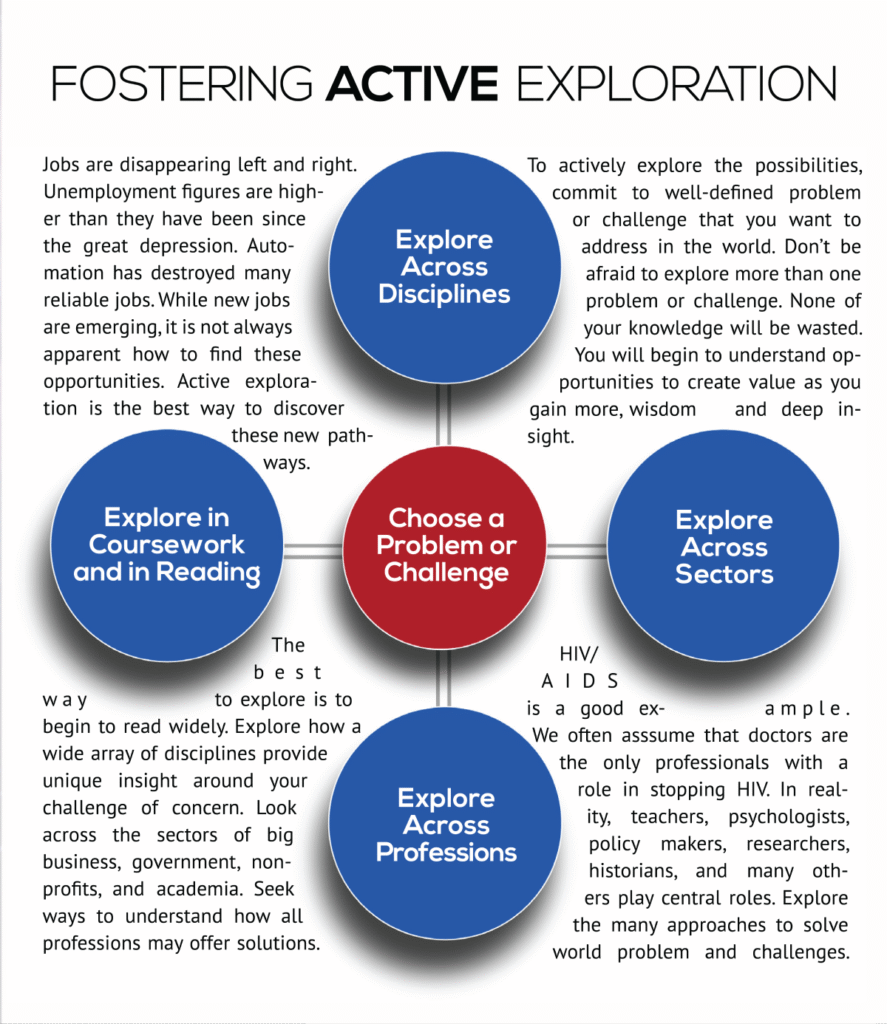
Because education is often focused on attaining a narrowly defined job or role, the learner is left at a disadvantage if that job or role disappears, is automated away, or if she is not interested in the role for which she has prepared. If instead, a learner is charged to learn to ‘create value’ around a defined problem, the ability to do so will continue to be an asset until the problem is solved. The innovation of a problem-based approach to exploration is that it challenges people to connect their professional training, disciplinary knowledge and humanity to make a difference in the world in their own unique way.
“i will create value for society, rather than extract it.” – rakesh khurana, Dean of Harvard college
The Realm of Possibility offers a new way for institutions to help students to actively explore based on a problem of concern or an inner imperative instead of focusing primarily on money, power, or prestige. Furthermore, it has the potential to reinvigorate the
spirit of exploration, entrepreneurship and innovation into a risk averse generation. Schools can frame their curricula, not only as a set of courses, but as a way to understand a problem of concern from a variety of disciplinary perspectives so that they may be a part of the solution come graduation, and as they inherit society.
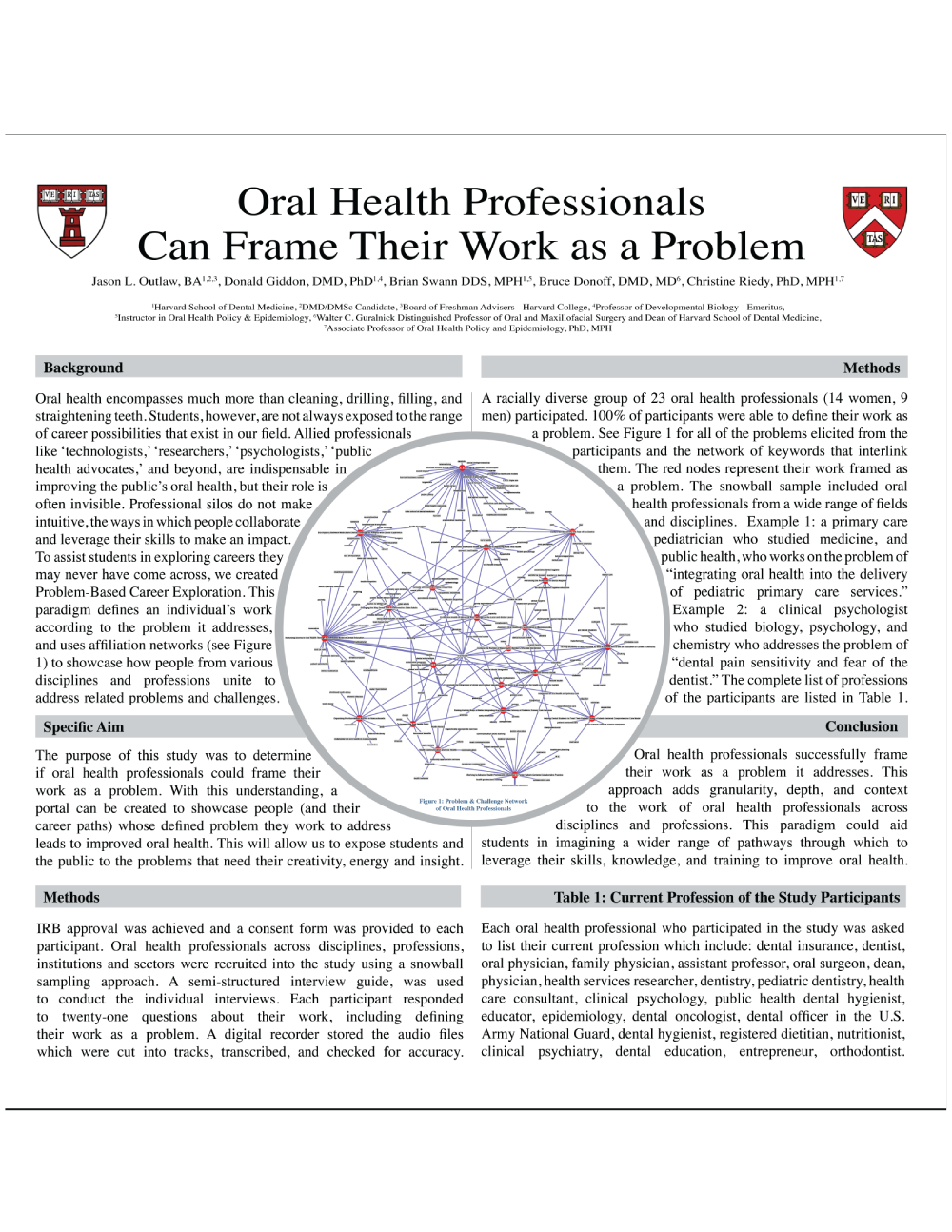
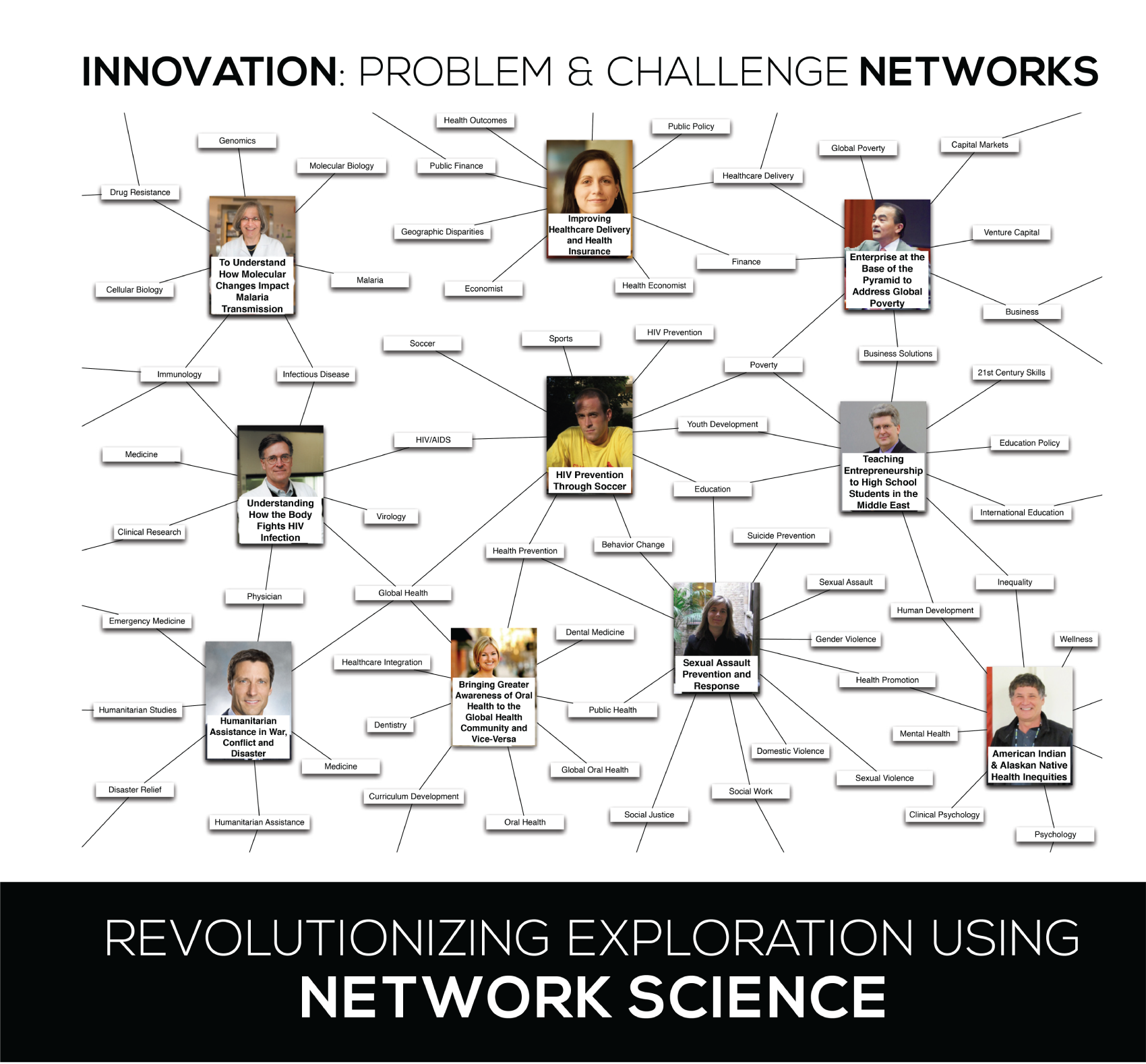
At the Realm of Possibility, we pioneered Problems & Challenge Career Networks, which unearth how individuals from different disciplines and professions come together to address important problems and challenges in the world. Access to these networks is stratified on education and race. We are committed to making this cultural capital more accessible to students who may not have had access to this information in their household or community, Collectively, Possibility Profiles offer an opportunity to help students think about perspectives they may never have imagined, and they help students to understand ways that their liberal arts education can be used to make the world a better place.
Silos and the Disciplinary Divide
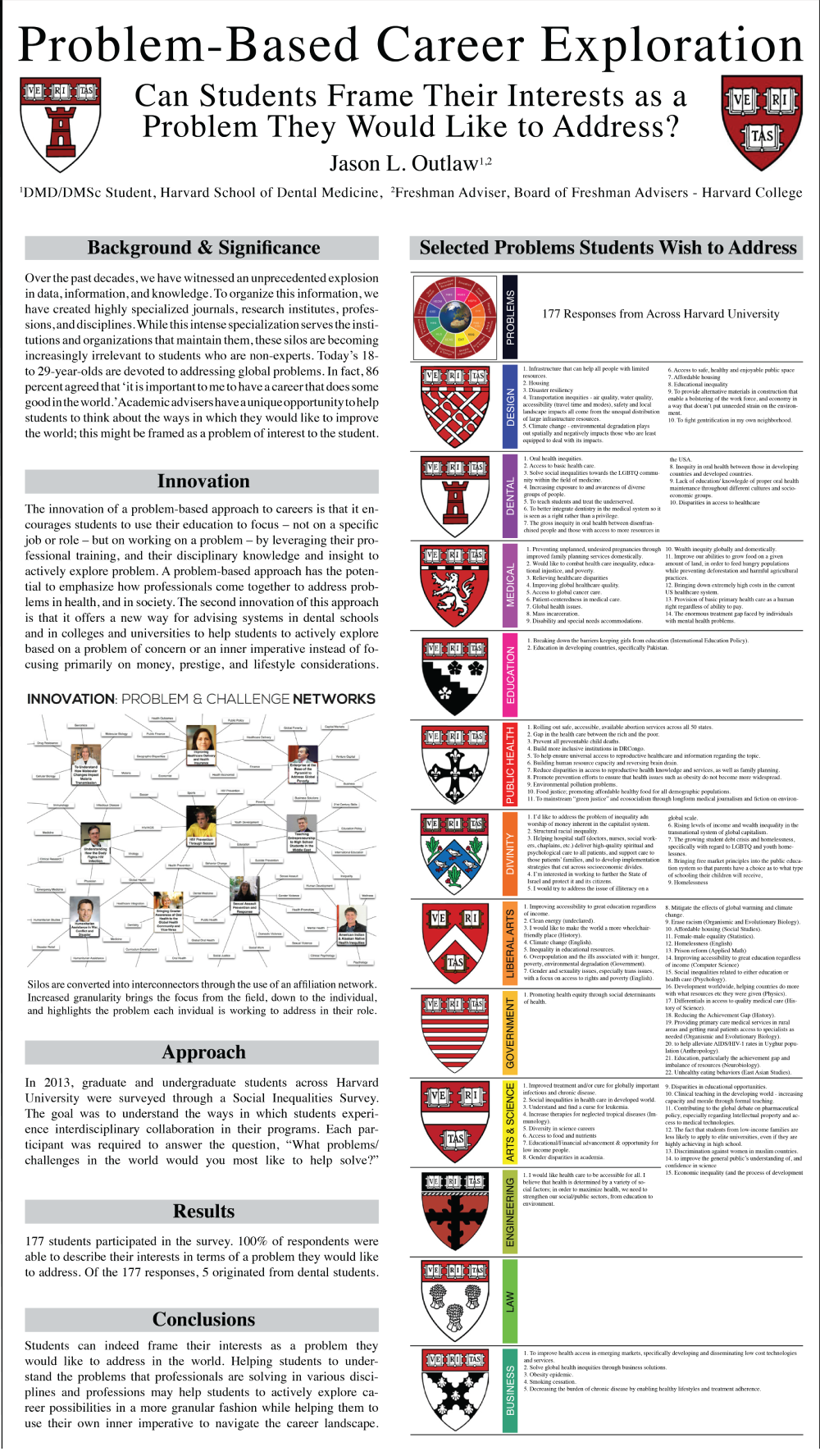
Over the past decade, we have witnessed an explosion in data, information, and knowledge. To organize this information, we have created highly specialized journals, research institutes, professions, and disciplines. While this intense specialization serves the institutions and organizations that maintain them, these silos are becoming increasingly irrelevant to students who are non-experts.
A Problem-Based Paradigm Aligns with the Mindset of the Millennial and Zoomer Generations
The literature suggests that the millennial generation engage with information in a completely new way. Digital Natives are no longer mere readers, listeners, or passive viewers but are active participants in public conversations using the internet and other technologies (Palfrey and Gasser 2008). Not only are millennials comfortable with technology they orient their work
according to an inner imperative. Today’s 18- to 29-year-olds are devoted to addressing global problems (Snyder 2013). In fact, 86 percent agreed that ‘it is important to me to have a career that does some good in the world’ (NSHSS 2013). Defining the work of professionals according the problem the person works to address brings granularity, meaning, and context to the work of the individual, and offers an opportunity to create an entirely new paradigm for defining and organizing work. Perhaps defining work according the problem being worked to address offers an opportunity to tether the person’s work to the bigger picture
According to the Merriam-Webster Dictionary, a problem is simply defined as, “a question raised for inquiry, consideration, or solution (Merriam-Webster 2014).” This definition is flexible enough to define most types of work, across the liberal arts and sciences. A problem-based career taxonomy also leaves space for students and professionals to examine the ways that different disciplines and professions come together to solve the problems we face in society.
”if you’re DoiNg iT for THe moNey, you’ll always be uNDerpaiD.” - scoTT bell
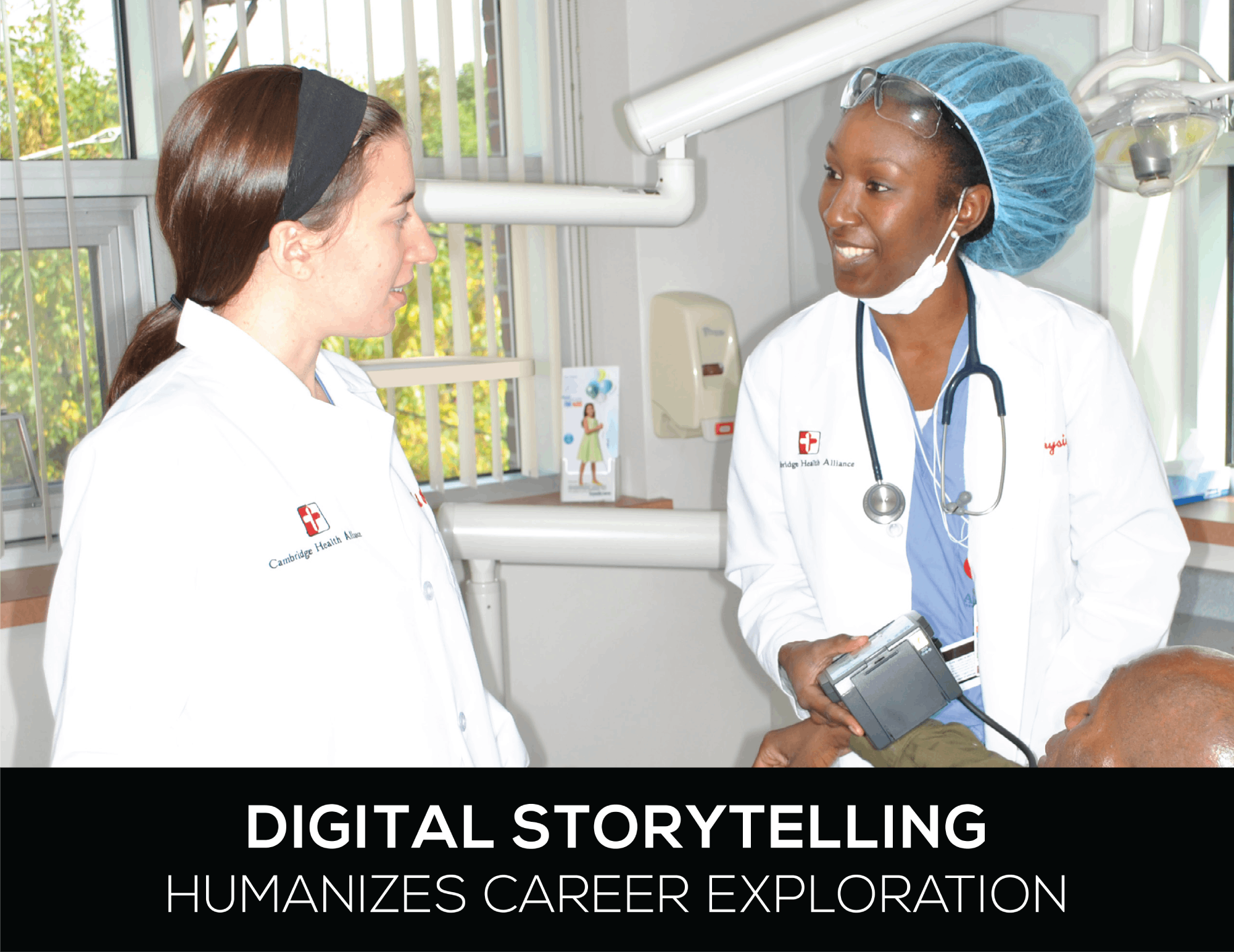
Telling ‘The Story Behind The Resume’ Humanizes Career Exploration
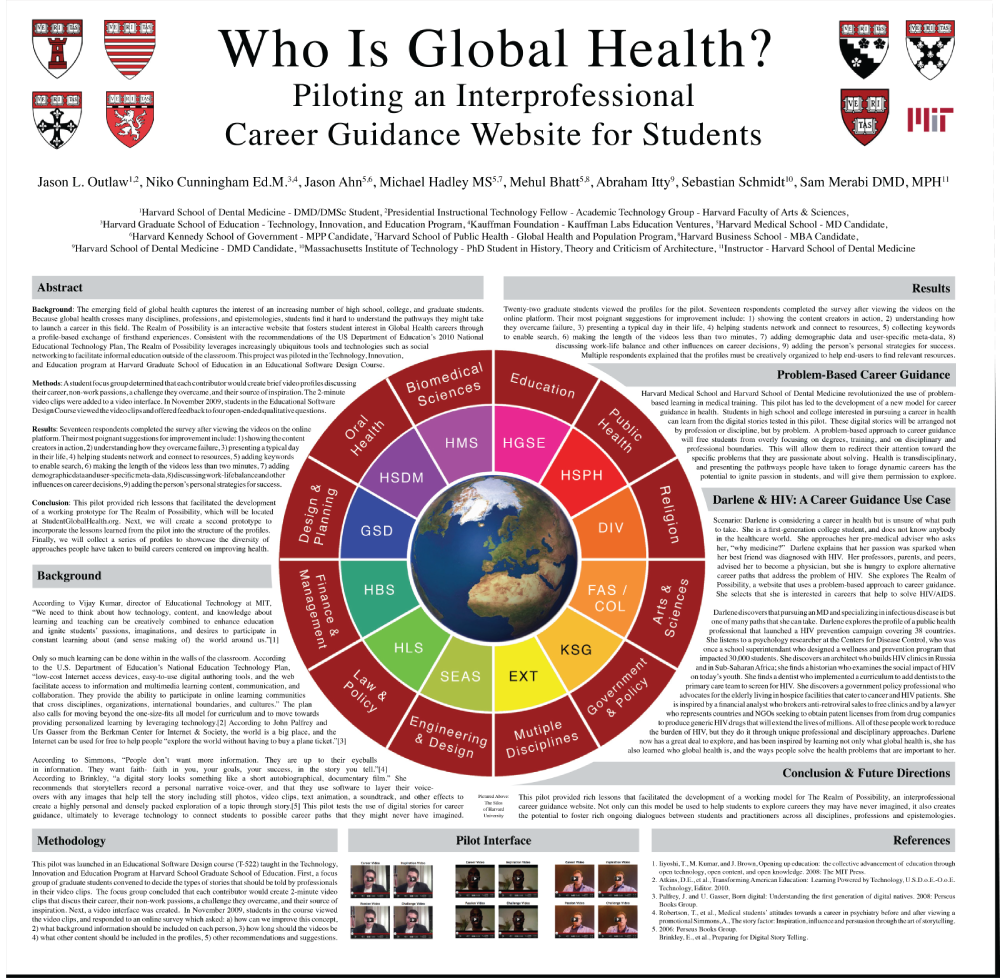
According to the Digital Youth Project, to stay relevant in the 21st century, educational institutions need to keep pace with the rapid changes introduced by digital media (Ito, Horst et al. 2008). In Opening Up Education, Dr. Kumar and Dr. Iiyoshi explained, “We need to think about how technology, content, and knowledge about learning and teaching can be creatively combined to enhance education and ignite students’ passions, imaginations, and desires to participate in constant learning about (and sense making of) the world around us”(Iiyoshi, Kumar et al. 2008).
It is important to understand that mere dissemination of information will no longer suffice. In the book, Story Factor, Simmons asserts:
“…People don’t want more information. They are up to their eyeballs in information. They want faith- faith in you, your goals, your success, in the story you tell. It is faith that moves mountains, not facts. Facts do not give birth to faith. Faith needs a story to sustain it – a meaningful story that inspires belief in you and renews hope that your ideas indeed offer what you promise” (Simmons 2006).
They assert that, the magic of influence is less in what we say and more in how. “Telling a good story is like giving a mini-documentary of what you have seen so others can see it too” (Simmons 2006). According to Brinkley, a finished digital story looks something like a short autobiographical, documentary film.” She recommends that storytellers record a personal narrative voice over, and to use software to layer their voiceovers with any images that help tell the story including still photos, video clips, text animation, soundtrack, other effects to create a highly personal and densely packed exploration of a topic through story. These digital stories can then be stored and played on any computer (Leneway, Brinkley et al. 2002). The impact of such stories can be amplified using the power of the Internet. It allows collective knowledge, capability, and resources embodied within broad horizontal networks of participants can be mobilized to accomplish much more a series of individual actors acting in isolation (Tapscott and Williams 2006). Digital stories focused on the problems people are working to solve will give students an opportunity to learn about the inner imperatives of the professionals working to improve the world across disciplines and professions, and to gain such exposure needing nothing more than an internet connection.

What Problems Are We Solving At
Harvard School of Dental Medicine?
leveragiNg TecHNology TO disseminATe cAReeR pOssibiliTies
Listen to Our Stories
Oral health crosses many disciplines and professions. We have created profiles on our faculty, students
and alumni to help you learn about them as professionals and to understand the impact they make in
the world through their work. Listen to their stories, and follow the link to browse their full profiles.
Technology Offers An Unprecedented Opportunity to Engage
The US government in fact recognized the importance of leveraging technology to engage learners in new ways. The U.S. Department of Education’s National Education Technology Plan (NETP) 2010 entitled, Transforming American Education: Learning Powered by Education discusses the role of technology in education. With respect to learning, they say:
“The model of 21st century learning described in this plan calls for engaging and empowering learning experiences for all learners. The model asks that we focus what and how we teach to match what people need to know, how they learn, where and when they will learn, and who needs to learn. It brings state-of-the art technology into learning to enable, motivate, and inspire all students, regardless
of background, languages, or disabilities, to achieve. It leverages the power of technology to provide personalized learning instead of a one-size-fits-all curriculum” (Atkins, Bennett et al. 2010).
The 2010 National Education Technology Plan also talks about the infrastructure needed or learning in the 21st century:
“Over the past 40 years, we have seen unprecedented advances in computing and communications that have led to powerful technology resources and tools for learning. Today, low-cost Internet access devices, easy-to-use digital authoring tools, and the web facilitate access to information and multimedia learning content, communication, and collaboration. They provide the ability to participate in online learning communities that cross disciplines, organizations, international boundaries, and cultures” (Atkins, Bennett et al. 2010).
“THe Task of a uNiversiTy is THe creaTioN of THe fuTure.” - alfreD NorTH wHiTeHeaD
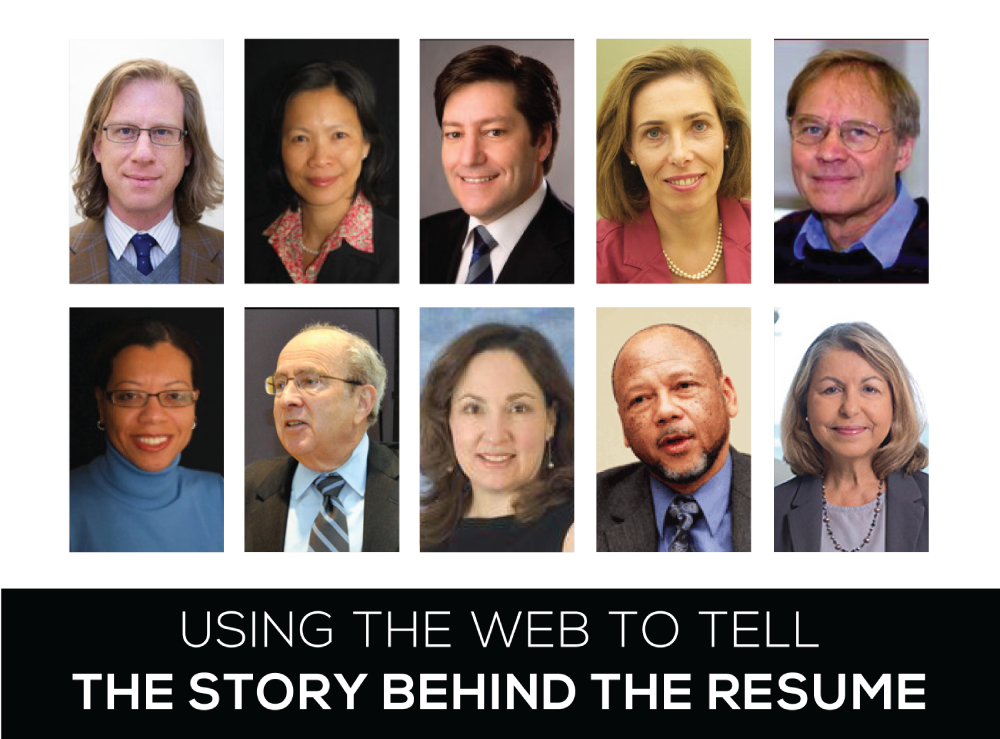
At the Realm of Possibility, we use the principles of educational software design, computer science, social network analysis, online organizing principles, and educational publishing, to craft digital stories that ‘tell the story behind the resume.’ Instead of focusing on broad swaths of the career landscape, our web profiles tease out the humanity of professionals and distills their story into a multi-media narrative that may be understood by all.
Dimensions of a Possibility Profile
As seen in the graphic to the right, a possibility profile is divided into twelve components. The digital stories lead with a description of the problem or challenge the person is working to address. This achieved through story so that even the most complex problem may be understood by a layperson. The next set of interview questions help people to understand the
skills that help this individual to succeed in their work as well as how to further explore their work. Very few people have linear paths as they traverse their careers, which is captured in the professional pathways questions, the inspiration questions, and the questions on their daily work routine.
The remaining questions focus on ideas that rarely come up on polite conversation. How do they create value for their organization and for society? How and with whom do they collaborate to achieve this? What is their vision for the future? What principles do they embody to navigate their lives? The final two questions directly asks people to describe the value of their education and asks them to discuss what brings them happiness and joy. The possibility profiles allow people to understand the things that make people tick, while underscoring how their work contributes to the greater good.
The Professional Pathways profiles on The Realm of Possibility features established individuals across professions and disciplines to highlight the story behind their resume. They are categorized according to the problem or challenge they work to address.
The Experience Exchange profiles on feature the ways in which people gain early real-world experience. These profiles showcase people who have found solid internships, research positions, jobs, volunteer positions, as well as people who have launched their own entrepreneurial endeavours.
realm of possibiliTy profile Types
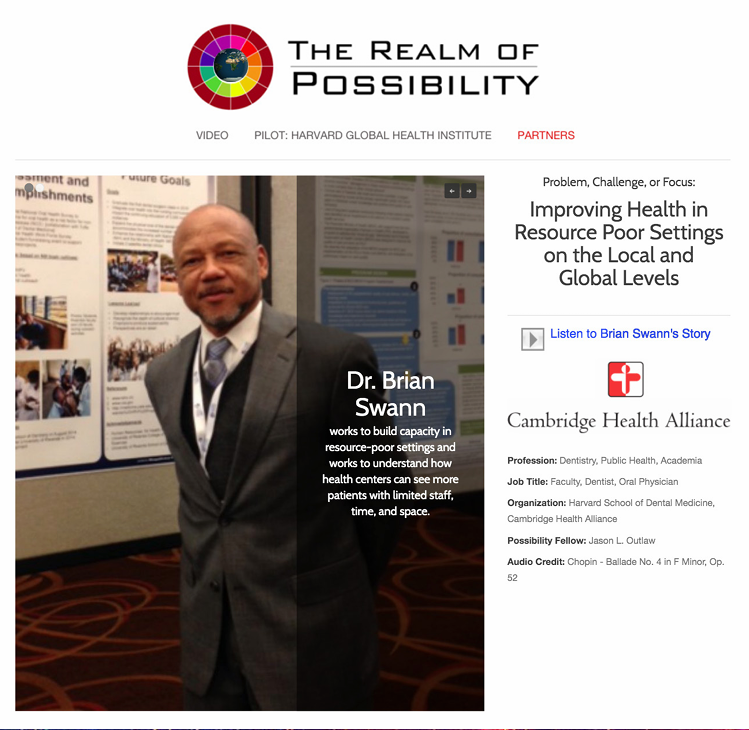
Audio Story Profile
This brief audio clip uses storytelling to highlight the importance of the problem or challenge they work to address through their career.
Professional Affiliations
Meta-data that categorize the interviewee are included on the possibility profile. This includes their job title, profession, and affiliation.
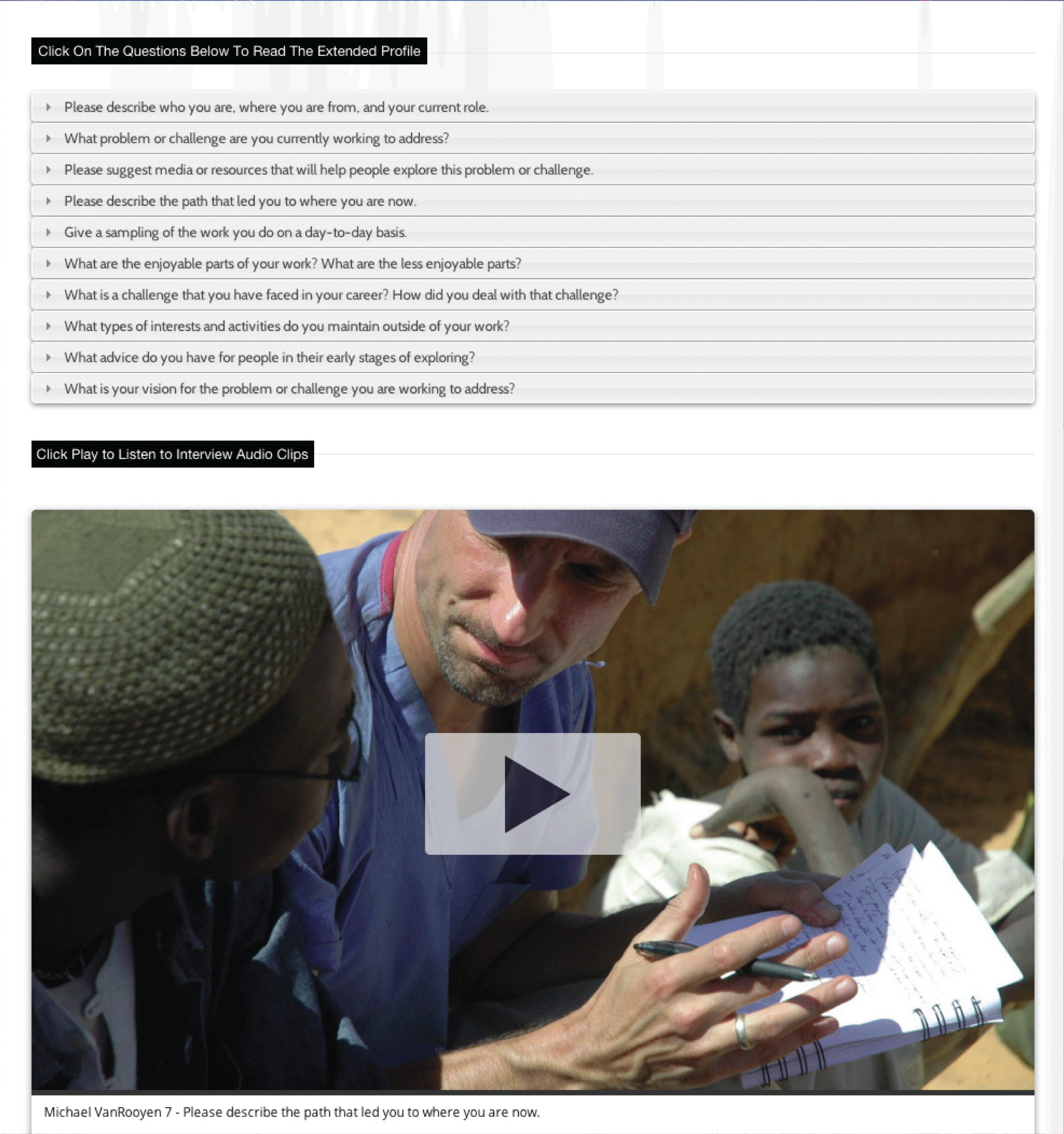
Interview Transcript
The entire interview is transcribed and edited for readability so that people can read the contents of the interview in full-text whenever they like.
Interview Podcast
The edited interview is cut into individual audio clips so that people who would like to hear the entire interview can do so at their leisure.
compoNeNTs of a possibiliTy profile
eXAmple: HTTp://THeReAlmOFpOssibiliTy.ORg/pROFiles/micHAel-vAnROOyen-HumAniTARiAn-AssisTAnce/
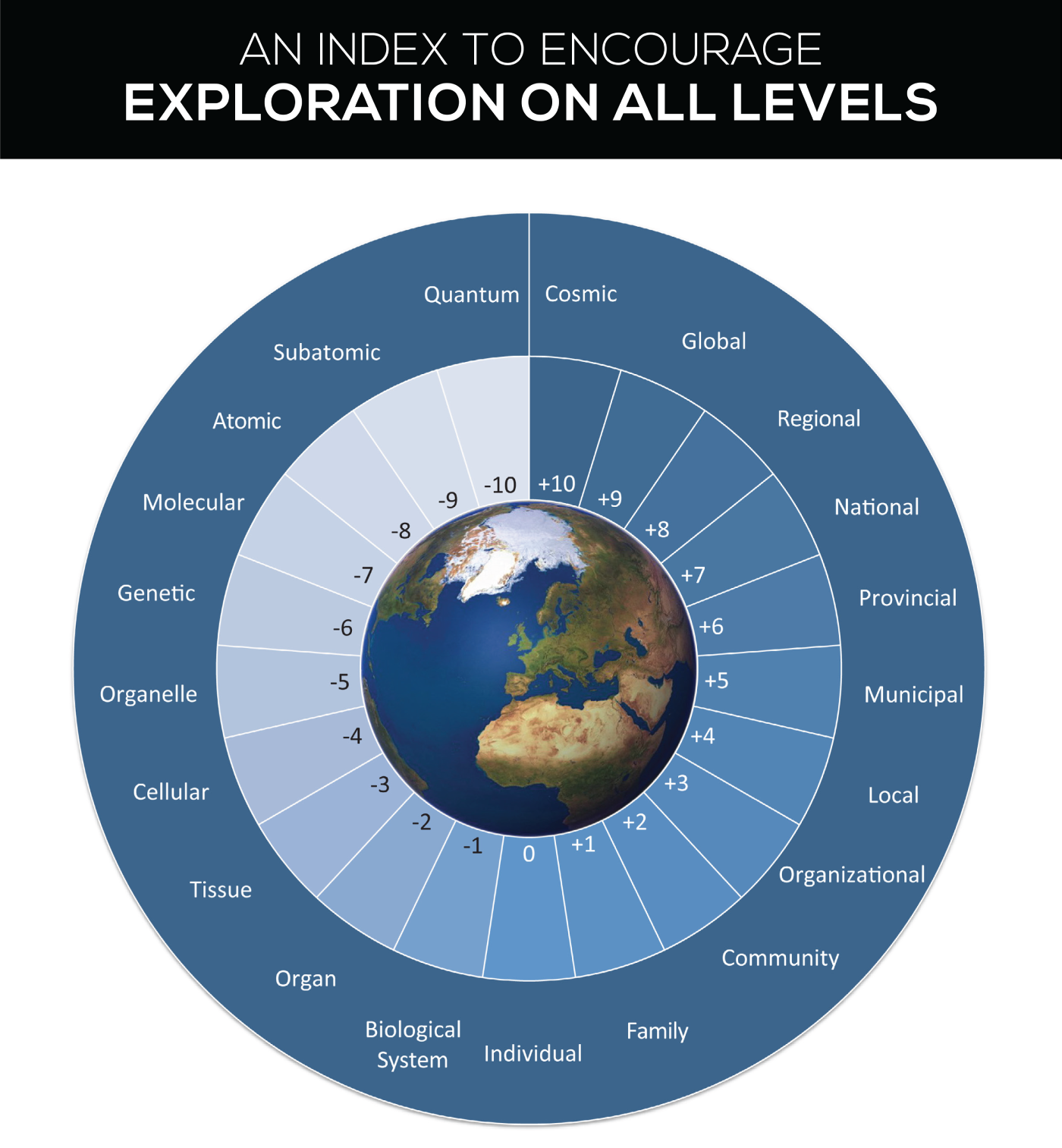
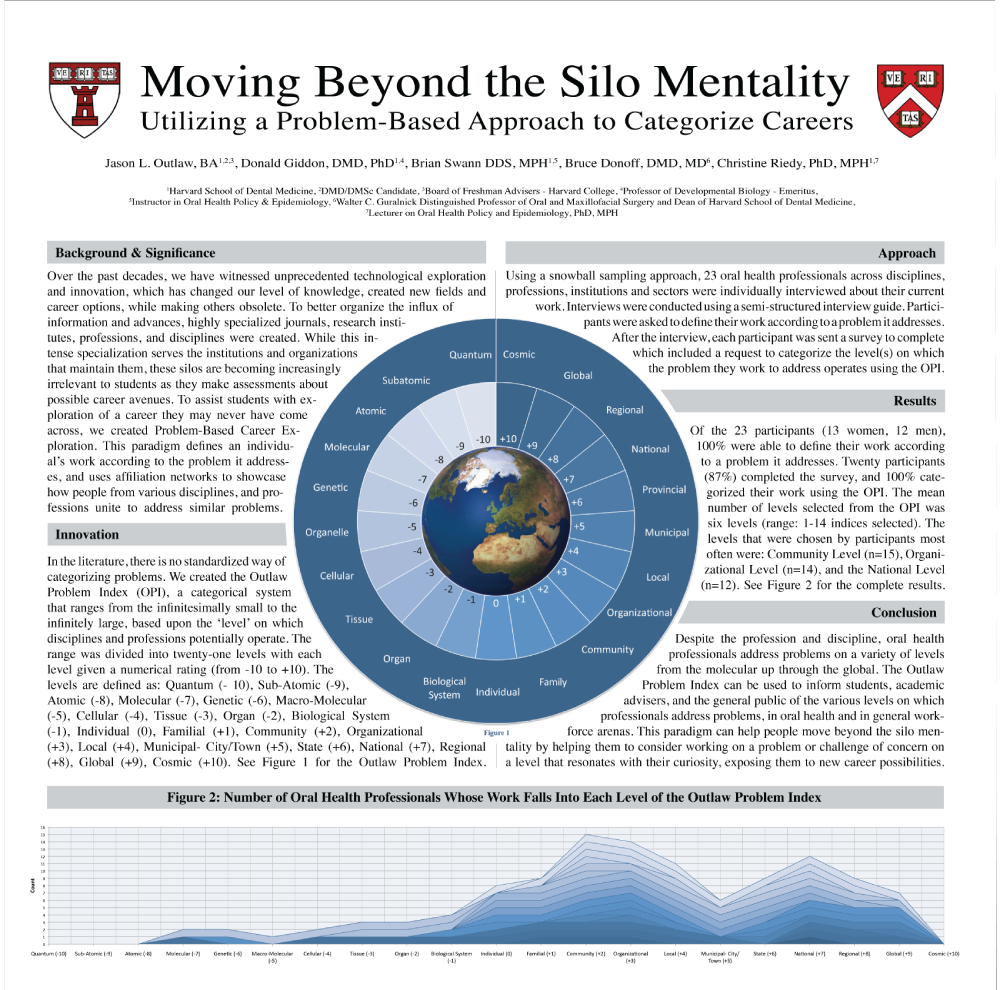
In the literature, there currently is no standardized way of categorizing problems, nor is there a problem-based categorization system so the Outlaw Problem-Based Index, was created. The Outlaw Problem Index (OPI), a categorical system that ranges from the infinitesimally small to the infinitely large, is based upon the ‘level’ on which disciplines and professions potentially operate. This draws from the concept of a compositional containment hierarchy, a system made up of a hierarchical
system of parts. While disciplines organize knowledge and professions organize people, there is no known way of categorizing problems. To create the OPI, the disciplinary continuum was divided into twenty-one slices. Each slice was given a numerical number ranging from -10 to +10. Each level is named based upon the levels on which disciplines work with -10 being the quantum level, 0 being the individual level, and +10 being the cosmic level. This system encourages focused exploration based on the persons interest.
A TOOl TO Help peOple Find people like THemselves
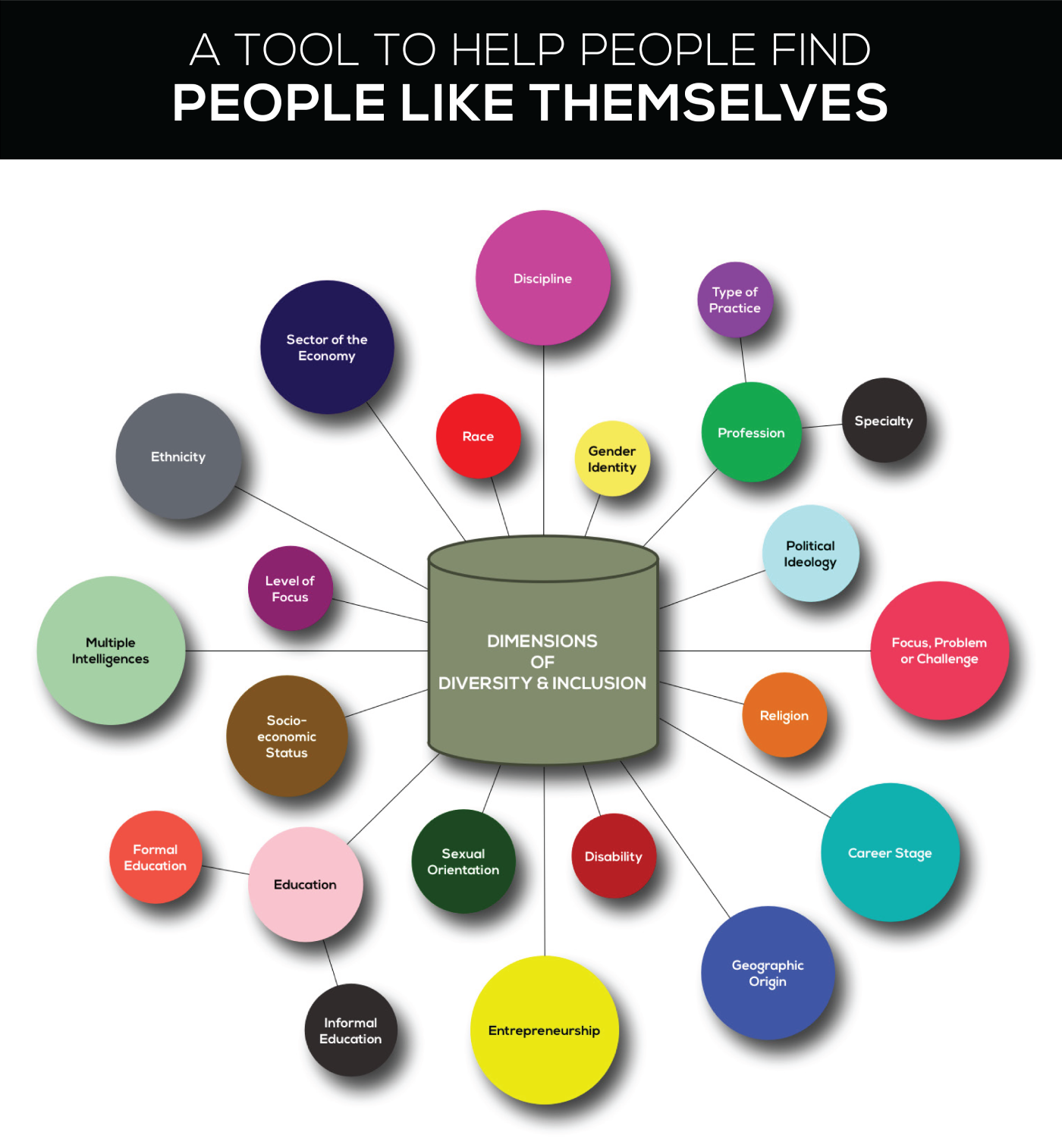
Dr. Francis S. Collins, director of the National Institutes of Health (NIH) stated that, “lack of diversity jeopardizes our ability to carry out the NIH mission because innovation and problem solving require diverse perspectives.” The Problem-Based Career Exploration paradigm directly underscores the importance of diversity and inclusion, however we have a more expansive scope of diversity. Young people, students, career changers, and curious explorers alike can “find people like themselves” based upon criteria
important to them based upon any of the below dimensions collected in Possibility Profiles. Because these data can be made quantitative, they can be improved, expanded, enhanced over time, and studied. As we collaborate to formulate pipeline, workforce, and disparities solutions, this expansion of diversity and inclusion can facilitate in generating nuance in helping people to discover individuals who are like themselves, who can help them to understand the possibilities, even if they have never formally met.